How hairdressers become perm specialists in Korea: licence and cost
In Korea it takes years to become a perm specialist: a state licence first, then 30 months of salon apprenticeship or six months of full-time study at an academy. Teaching is a separate, later stage. This article sets out how that path works, what it costs and what it means for a hairdresser choosing Korean perm training.
In short
- In Korea you may only do perms with a hairdresser's licence (미용사 면허).
- The national exam has a written and a practical part, and the pass mark is 60. In 2024, 53,456 people sat the written part and 16,020 passed.
- After the licence, training continues: 30 months of apprenticeship in a salon or 6 months of full-time study at an academy.
- The six-month course at Juno Academy cost 17,306,000 won for the 2025 intake; the academy website now lists 18,443,000 won.
- A teacher needs a separate qualification. For vocational training this means a licence, at least 2 years of experience and specific teacher training.
- A short programme for a foreign hairdresser gives you the technique, but it does not make you a teacher.
Author: Oksana Prisyazhnaya. Founder of Versiya Lab Academy, training organizer
In this article:
- Do you need a licence to do perms in Korea?
- How the licence is obtained
- How the national exam works
- How long training lasts after the licence
- What the path to becoming a stylist costs
- Who is allowed to teach in Korea
- What short programmes for foreigners offer
- Who to learn from: two types of training
- My experience: a conversation during my training in Seoul
- My conclusion
- How Versiya Lab Academy works
- Frequently asked questions
- Glossary
- Sources
Do you need a licence to do perms in Korea?
Yes. Under Article 6 of the Public Health Control Act (공중위생관리법), a hairdresser must obtain a licence from the head of the city, county or district.
Perming is explicitly part of the work covered by the 미용사(일반) licence: perms, cutting, styling, scalp care and colouring. Only a licensed person may open a salon or work in one.
How the licence is obtained
The law sets out three routes:
1. Graduate from a relevant department of a college or university.
2. Complete a hairdressing course at a higher technical school.
3. Obtain the national technical qualification 미용사, that is, pass the state exam.
The system is described in detail in a review by the Korea Institute for Health and Social Affairs (KIHASA).
How the national exam works
The exam is run by the state human resources development agency. It has a written and a practical part, and you need at least 60 points in each.
According to the 2024 statistics, 64,404 people applied for the written part, 53,456 sat it and 16,020 passed. That is roughly one in three.
The practical part is prepared task by task: cutting, winding on perm rods, blow-drying, setting on rollers, washing and scalp care, colouring.
How long training lasts after the licence
The licence is the way into the profession. There are two routes from it to working with clients on your own; below is the example of Juno Hair, the largest Korean salon chain.
Route | Length | What it involves |
|---|---|---|
Salon apprentice | Winding, styling, colouring, basic cutting, then a diploma and a start as a stylist | |
Stylist preparation course | Full days, Monday to Friday, 9:30 to 17:30, practice on models |
The six-month course only accepts people who already hold the licence. The Korean hairdressers' association quotes its motto: 180 days devoted to nothing but training.
What the path to becoming a stylist costs
The six-month course at Juno Academy cost 17,306,000 won for the 2025 intake; the academy website now lists 18,443,000 won. A group has about 12 people; textbooks are included in the price and materials are paid for separately. The 2021 intakes cost 14,400,000 won.
On top of that comes six months of living in Seoul without earning.
Who is allowed to teach in Korea
Teaching is the stage that follows working as a stylist, and it has its own requirements.
- Enforcement decree of the Academies Act, Article 12: the qualification of an academy teacher is set out in a separate annex to the decree.
- The vocational training teacher qualification (직업능력개발훈련교사): a national licence, at least 2 years of practice or teaching, and specific teacher training.
- Job postings at beauty academies ask for a hairdresser's licence and a vocational training teacher certificate.
- At Juno Academy the stylist course is taught by working salon directors and the chain's best stylists.
The order is always the same: first years of work with clients, then the right to teach others.
What short programmes for foreigners offer
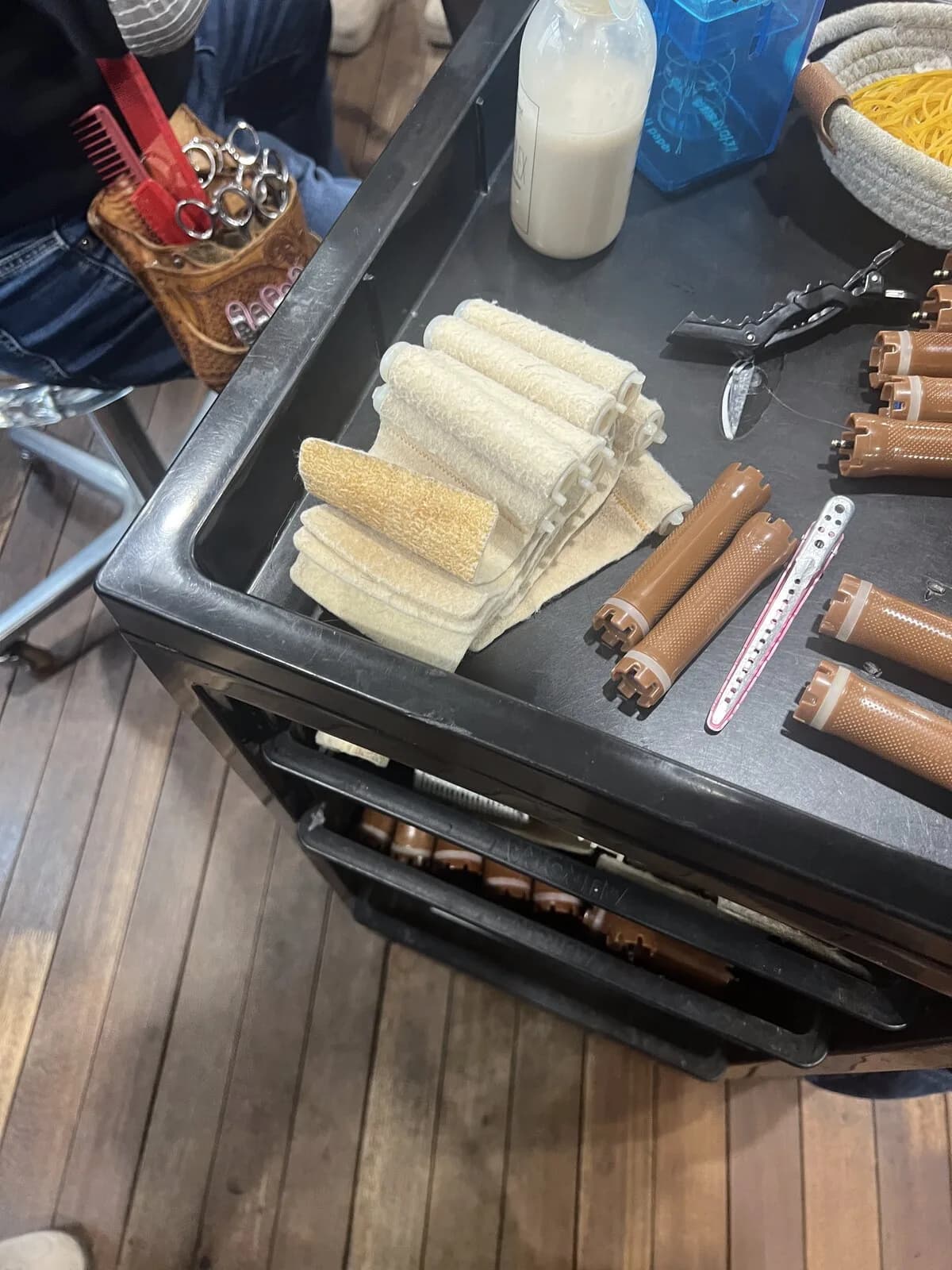
The technique, first-hand. One example is the K-beauty programme at Sungshin Women's University for people in the industry: it lasts 10 days, and for groups it is shortened to 6. In that time participants cover cutting, blow-drying, and both regular and heat perms.
An experienced hairdresser takes the technique home and builds it up on their own clients. It is a strong start for practice. In the Korean sense, a short programme does not make you a teacher.
Who to learn from: two types of training
What to compare | A teacher from a Korean academy | A graduate of a short programme |
|---|---|---|
Their own path | Licence, years of work with clients, a position at an academy | A few days of training in Korea |
Where the technique comes from | First-hand | Retold |
Teaching credentials | Position and qualification at the academy | A participant's certificate |
How they handle difficult hair | Years of practice and the academy's method | Their own experience after the course |
My experience: a conversation during my training in Seoul
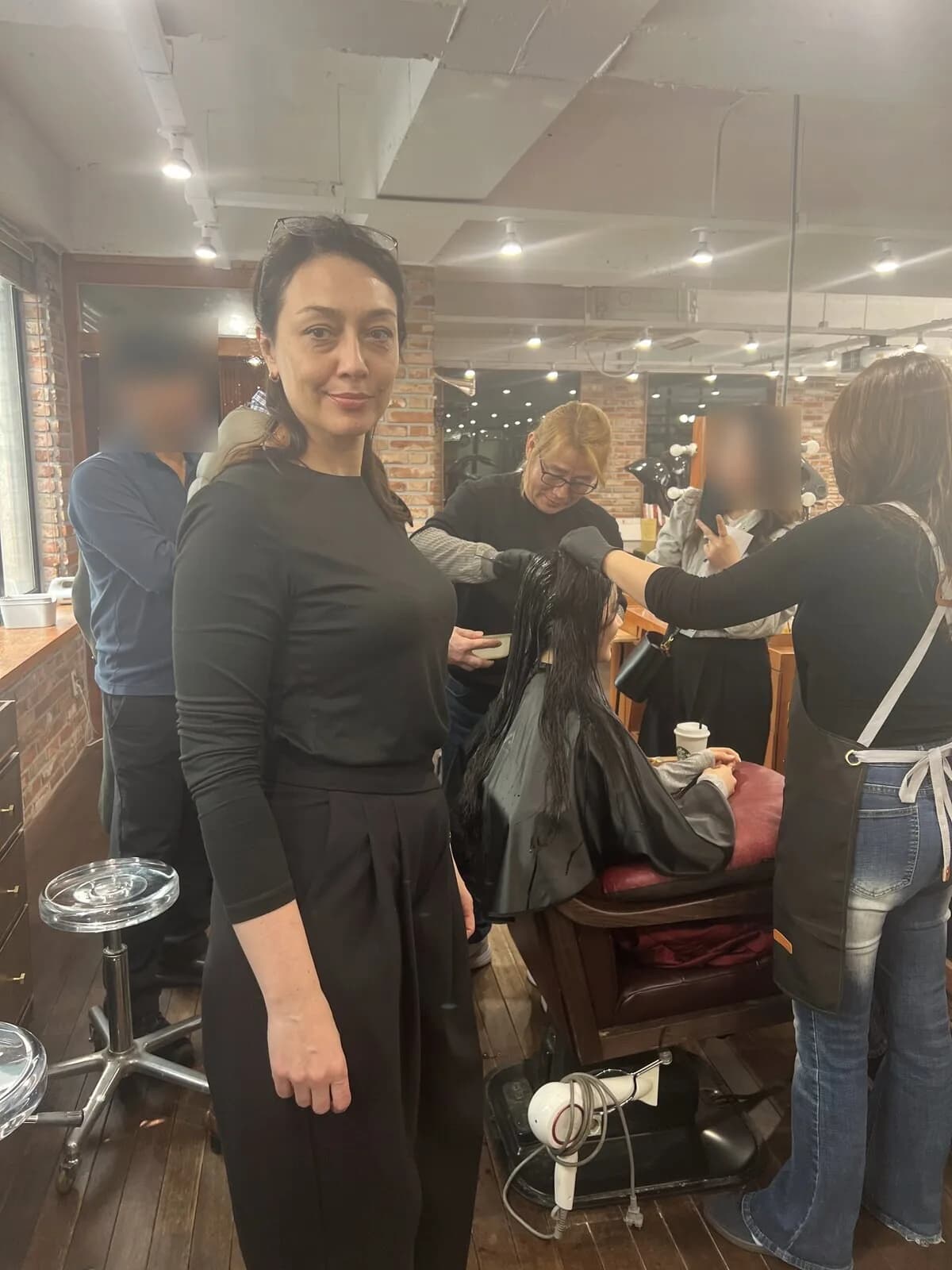
I trained in the Korean perm in Seoul twice, in March and in August 2026. My teacher is Hong Jihoon, Creative Technical Director of MASSTIGE HAIR Academy.
In August we were practising winding on a mannequin when the teacher suddenly asked: "To work as a hairdresser in Russia, do you need to get a licence?" I answered that nobody checks whether you have a certificate. He asked again: "So you can open a beauty salon anywhere?" - "Yes, people just open them."
For him this was a revelation. In Korea, he explained, the requirements for hairdressers are the strictest in the whole beauty sector, and a hairdresser cannot work without a certificate.
The conversation was caught on video.
After that conversation I began to look into how his own path, and the path of any Korean hairdresser, is built. Everything written above is what I gathered then.
My conclusion
I am not in a position to teach the Korean technique myself. A few days of training, even with a strong teacher and on a live model, give me the technique to work with clients. They do not give me the right to teach it to other hairdressers, either by Korean standards or by my own.
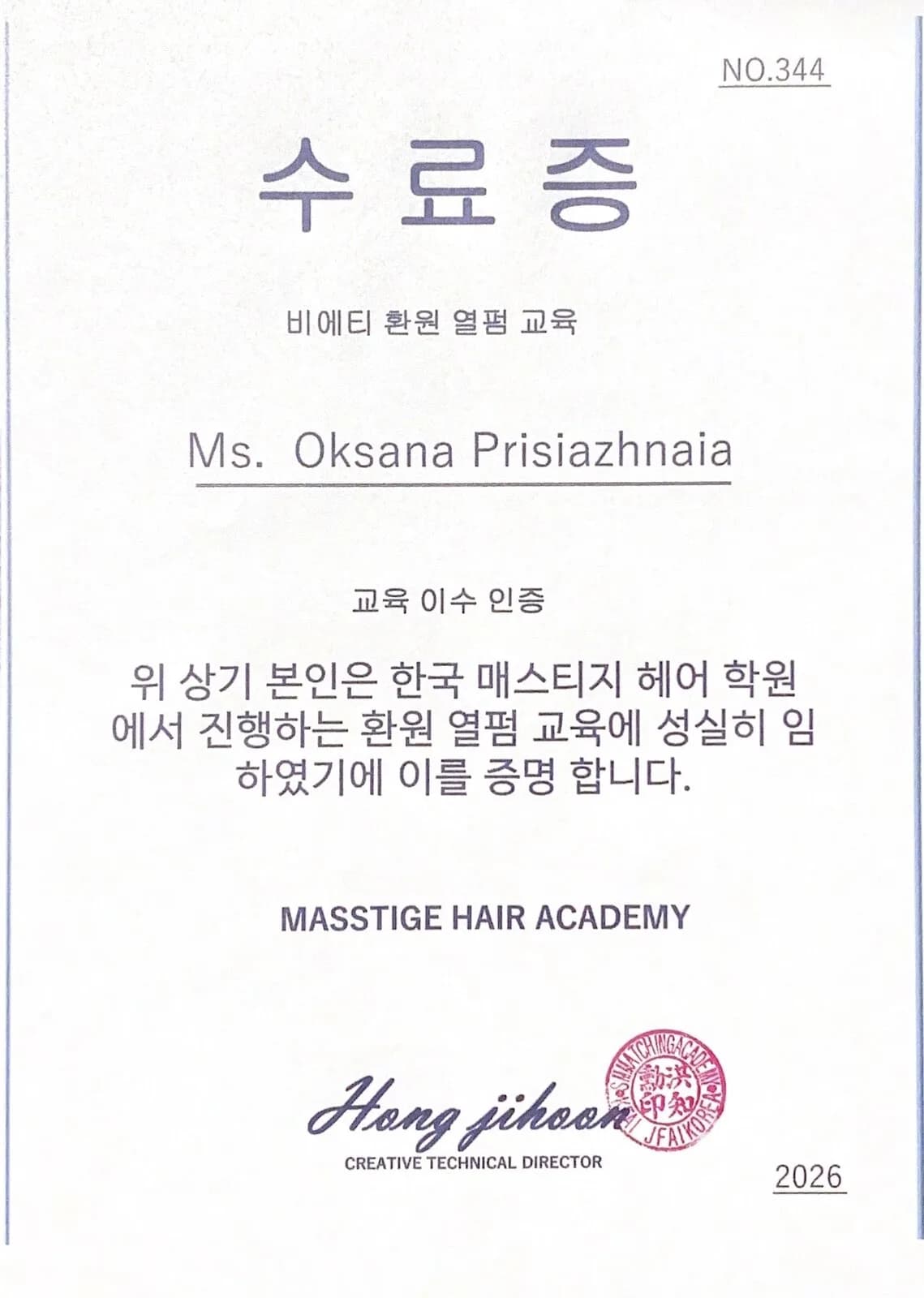
My document from Seoul is called 수료증. It is certificate of completion No. 344 from MASSTIGE HAIR Academy, signed by Hong Jihoon. It confirms that I completed the course. It is not a teaching qualification.
So I gave up the idea of running a course myself and made a different decision: to bring a Korean teacher to hairdressers in Russia and to take hairdressers to him in Seoul.
How Versiya Lab Academy works
- The technique is taught by Hong Jihoon in person.
- I organise the training, interpret and help adapt the technique to Slavic hair.
- Formats: a course with a Korean teacher in Moscow and training in Seoul.
This way a hairdresser in Russia gets the Korean school first-hand.
Frequently asked questions
How many years does a Korean perm specialist train? After the licence: 30 months of apprenticeship in a salon or 6 months of full-time study at an academy.
How much does it cost to train as a stylist in Korea? The six-month course at Juno Academy cost 17,306,000 won for the 2025 intake; the academy website now lists 18,443,000 won. Materials are paid for separately.
Does a short-course certificate make you a teacher? No. It confirms that the hairdresser has completed the programme.
Who teaches the technique at Versiya Lab Academy? Hong Jihoon, Creative Technical Director of MASSTIGE HAIR Academy (Seoul).
What should you ask before choosing a course? Who personally teaches the technique, where and for how many years they trained and worked themselves, and whether you work with your own hands on the course.
Glossary
- 미용사 면허 - the state hairdresser's licence.
- 미용사(일반) - the national qualification of a general hairdresser; it covers perming.
- 학원 - a private academy, operating under the Academies Act.
- 직업능력개발훈련교사 - a vocational training teacher, a separate state qualification.
Sources
- Public Health Control Act, Article 6
- KIHASA: the hairdresser's licence in Korea
- Exam statistics for 미용사(일반), 2024
- Juno Academy: stylist preparation course
- Juno Academy: 2025 intake
- Juno Academy: stylist preparation course, current intakes
- Juno Academy: 30-month programme
- The Korean hairdressers' association on the Juno course
- Enforcement decree of the Academies Act, Article 12
- Vocational training teacher qualification
- Sungshin Women's University: K-beauty programme for foreigners
Author: Oksana Prisyazhnaya, founder of Versiya Lab Academy. Data as of 12 October 2026.
© Oksana Prisyazhnaya, 2026. Text, photos and video are original. Use only with the author's written permission.