How a Korean hairdresser works differently
Diagnosis, a test strand for every client, the machine as an everyday tool, and a refusal when the hair will not cope. What a Korean hairdresser does differently - a view from Seoul.
Author: Oksana Prisyazhnaya. Founder of Versiya Lab Academy, training organizer
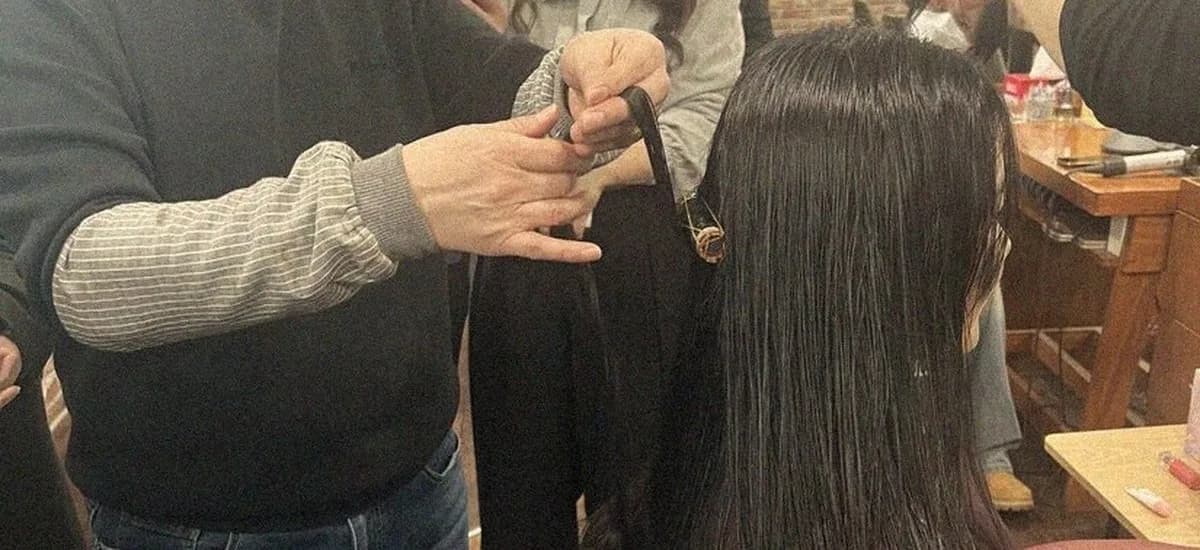
In Russia, "Korean hairdresser" is searched on Yandex, and the suggestions show that many people hope to find a Korean stylist in Moscow. I do not know of Korean stylists who take clients in Moscow. There are people who trained with them. I am Oksana Prisyazhnaya, and I trained twice, in March and in August 2026, with Hong Jihoon, Creative Technical Director of MASSTIGE HAIR Academy in Seoul. Here is what a Korean hairdresser does differently. Not because of genius, but because that is how they were taught and what the client expects.
At the class the teacher asked me whether a hairdresser in Russia needs a licence to work. I answered that nobody checks certificates and you can simply open a salon. "Wow," he said. In Korea a hairdresser cannot work without a certificate, and the requirements are stricter than in cosmetology.
At the March seminar in Seoul three things surprised me on the very first day. How fast Korean hairdressers work. That every procedure is done with at least four hands: for the client it is much faster. And how many additional tools they have, for example vaporisers for restoration. Restoration gets a great deal of attention there in general: the client should walk around with healthy, shiny hair.
In Korea the perm is a core service, not an extra
In our salons the perm sits on the price list somewhere after colouring and cutting, and a hairdresser does one every couple of weeks. In Korea the perm is the reason people go to a salon. Root volume, C-curl, S-curl, digital perm on a machine, cold perm with a Korean solution - these are separate services with separate prices, done several times a day. Everything else follows from that: the hand, the speed, the confidence in diagnosis. A Korean hairdresser is not afraid of a perm, because for them it is not an event.
Diagnosis takes as long as our whole consultation
The first thing a Korean hairdresser does is look at the hair. Not "what length would you like", but where the hair comes from, what has been done to it, how it behaves wet and dry, where it breaks, where it is porous. The conversation about the shape of the curl starts only after that. With us the order is often reversed: first "I want it like in the photo", then an attempt to do it on hair that will not cope. In Seoul I was told straight away which hair I would be turning down. It was the first thing I wrote down.
Everyone gets a test strand
In Korea the test strand is part of the procedure, not a just-in-case precaution. One strand is wound, the hairdresser watches how the hair takes the solution and responds to the machine, and only then decides which solution, which settings and whether to go ahead at all. In my studio every new client gets a test strand, sometimes twice in one procedure. Clients are surprised. A Korean client would be surprised if it were skipped.
The machine is an ordinary tool
A digital perm machine stands in a Korean salon as casually as a hood dryer does in ours. The hairdresser knows what the machine does to the hair and is not afraid of it. With us the machine perm is still a "new technology": people either leave it alone or work from videos with someone else's settings. The Korean school teaches why each step is needed, and then the settings stop being magic. What exactly and in what order is the content of the course, not of an article.
Care is part of the perm, not an upsell
In Korea, restoration is built into the procedure. Perm solutions come paired with care that is applied before, between the stages and after, and the client leaves with hair that looks better than before the perm. With us, care is a separate line on the price list, offered if the client asks. A Korean hairdresser does not ask: without care they will not answer for the result, so care is not up for discussion.
Saying no is a normal part of the job
A Korean hairdresser says no if the hair will not cope, and the client accepts it. Nobody says "let's give it a try". I brought this rule to Moscow unchanged: a test strand, an honest refusal if the hair will not cope, and no "let's try a gentler solution". It is the only reason there is no ruined hair in my reviews.
How much of this can be learned in one day?
Diagnosis, the test strand, the logic of working with the machine, the order of care - yes, these are set up in one course day plus practice on your own model; after that it takes practice. Speed and a trained hand - no, those take years. In spring 2027 there is one such day in Moscow for ten people: Hong Jihoon demonstrates the technique on a live model, and I show how it is adapted to Slavic hair. The schedule is in the programme of the day; the price and deposit are in the terms of participation. How training works in Korea itself is covered in How perming is taught in Seoul.
© Oksana Prisyazhnaya, 2026. Text, photos and video are original. Use only with the author's written permission.